With millions of tactical enthusiasts migrating between Chess.com and premier board game hubs like Checkers.com, the ancient game of draughts is undergoing a digital renaissance. However, many players who excel in chess find themselves unexpectedly outmatched on the checkerboard. They treat checkers like simplified chess—only to watch their pieces swept away by swift, lethal combinations.
In reality, checkers is governed by radically distinct mathematical rules: uncrowned pieces can never retreat, captures are strictly compulsory, and the concept of "The Move" (Opposition) creates sudden zugzwang that forces resignation. In this definitive guide, we unpack why traditional chess instincts fail in checkers, outline the top tournament opening lines used by master tacticians on Checkers.com, and show you how to utilize our free in-browser Checkers Move Calculator & Screenshot Solver to evaluate positions up to 14 plies deep.
Key principles to dominate Checkers.com & Chess.com draughts:
- Forget Passive Defense: In checkers, every advance is irreversible. You cannot maneuver a pawn backward to defend. You must defend actively through diagonal counter-threats.
- Play Proven Opening Systems: Open with 11-15 (The Old Faithful) or 9-14 (Double Corner). Contest squares 14, 15, 18, and 19 while keeping your home rank intact.
- Weaponize Forced Sacrifices: Exploit the compulsory capture law. Sacrificing 1 piece to force the opponent into a 2-for-1 capture wins matches against even top-tier opponents.
- Drive Kings to Single Corners: In 2 Kings vs 1 King endgames, herd the lone enemy King toward squares 4 or 29. Never allow them to find refuge in the double corner (squares 1 & 5).
- AI Screenshot Solver: Upload any board snapshot to Next Checkers Move to see the mathematically optimal move calculated in 35ms.
Why Chess Players Blunder on Checkers.com
Chess grandmaster Edgar Allan Poe famously argued in The Murders in the Rue Morgue that checkers requires greater calculating sharpness than chess because the pieces are uniform and every step carries immediate, irreversible consequences.
Top 3 Tournament Opening Systems on Checkers.com
Just as 1.e4 or 1.d4 define competitive chess, opening systems in checkers establish diagonal control and piece coordination. In standard 1–32 American notation, here are the three most formidable openings:
1. The "Old Faithful" System (11-15)
Black's move 11-15 is the king of checkers openings. By occupying square 15, Black seizes central space and cuts the board in half.
- The Old Fourteenth (11-15 23-19 8-11 22-17 4-8): The most thoroughly analyzed variation in draughts history. Both sides contest the central wedge with rock-solid solidity.
- The Cross (11-15 23-18): A sharp, aggressive response where White immediately strikes Black's advanced outpost on 15. Leads to fast-paced tactical exchanges.
- The Single Corner (11-15 22-18 15x22 25x18): An early piece trade that clears central lines and rewards players with deep endgame knowledge.
2. The Double Corner Opening (9-14)
Moving 9-14 shifts the focus of the battle toward White's single corner and Black's double corner. It avoids the heavy theoretical preparation of 11-15 and offers asymmetrical counter-attacking opportunities.
3. The Bristol Opening (11-16)
The Bristol (11-16) is a sophisticated flank opening favored by positional masters. It invites White to occupy the center while Black sets up flank pins and prepares rapid king-side promotions.
Mastering the Endgame: Drummond's First Position & King Traps
In competitive matches on Checkers.com, reaching a King endgame does not guarantee a win unless you know the precise mathematical technique.
1. The 2 Kings vs 1 King Technique
If your opponent has a single King, your goal is to force them into the Single Corner (squares 4 or 29).
- Position one King on the main diagonal (e.g., square 14 or 19) to cut off the lone King from crossing to the opposite side of the board.
- Use your second King to advance and push the lone King toward the single corner wall.
- Once the enemy King is driven into square 4 (or 29), slide your pinning King onto the adjacent diagonal square (square 8 or 25). The lone King has zero legal moves and is trapped!
2. John Drummond's "First Position"
First Position is the most famous fundamental endgame in draughts history. It involves 2 Kings and 1 single pawn versus 2 Kings and 1 single pawn. Even though material is perfectly equal, the attacking player holds a forced win because their Kings occupy the dominant diagonals and control "The Move".
Grandmaster Tip: The Breeches Fork
The "Breeches" (or the Fork) occurs when a crowned King steps directly between two enemy pawns that are separated by an empty diagonal space. Because the King can capture in both directions, the opponent can only protect or move one piece, guaranteeing that your King captures the other piece on the next turn.
How to Solve Checkers.com Positions with Next Checkers Move
Whether you are analyzing a blitz game played on Checkers.com or studying a master puzzle, Next Checkers Move brings chess-engine-grade analysis directly to your web browser.
How to Solve Checkers.com Matches Step-by-Step:
-
Snip Your Game Screen: Use your operating system's screenshot tool (
Win + Shift + Son Windows,Cmd + Shift + 4on Mac) to copy your active Checkers.com board. - Launch Next Checkers Move: Open Next Checkers Move (https://nextcheckersmove.com).
-
Scan Board from Screenshot: Click 📷 Scan Board from Screenshot and press
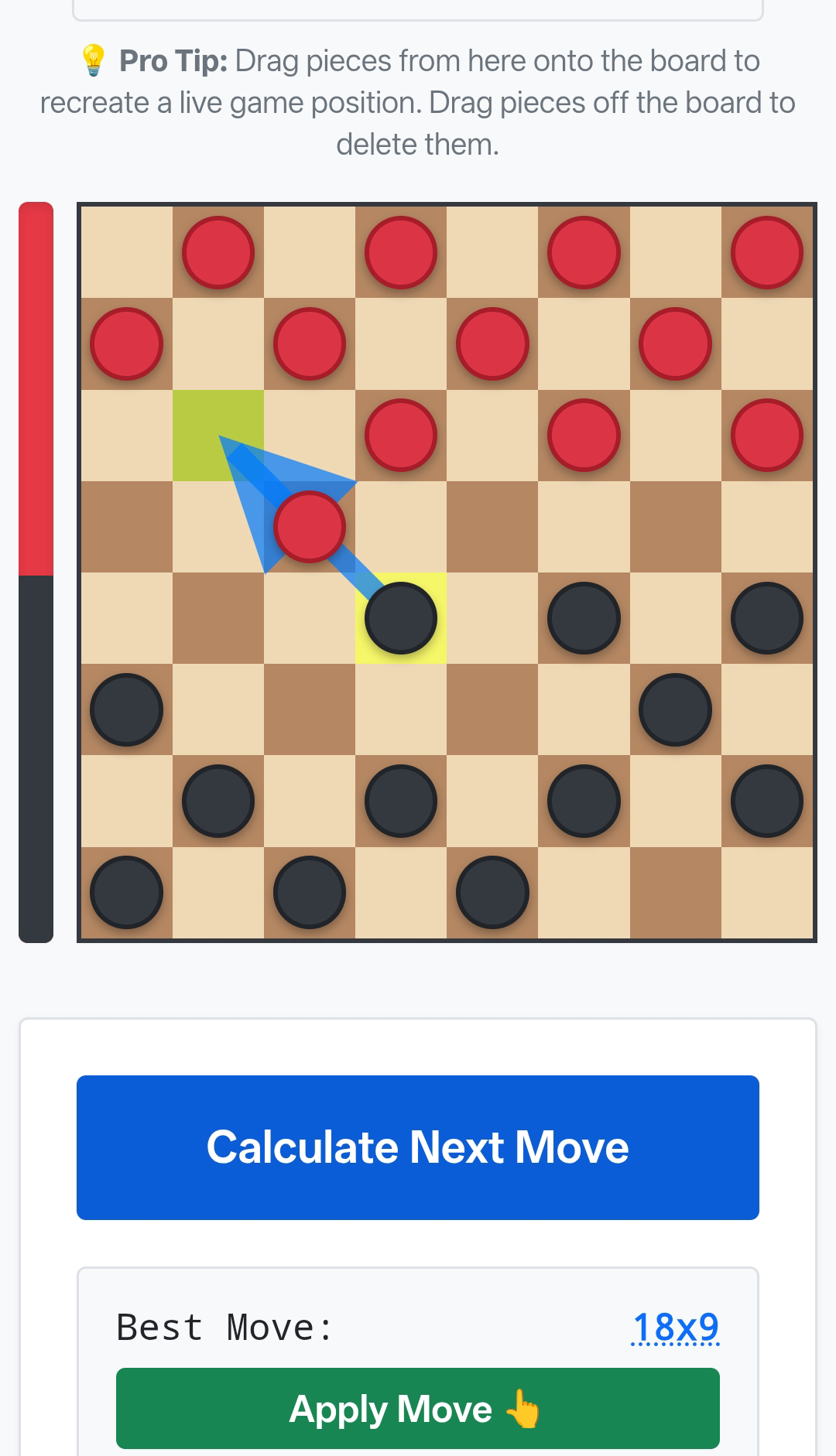
Ctrl + Vto paste your image. Our Optical Board Recognition (OBR) AI maps dark squares and identifies Red/Black pawns and Kings automatically. - Instant Engine Evaluation: Click Calculate Next Move. Our 14-ply Minimax bitboard solver processes the position in approximately 35 milliseconds, displaying a sharp blue arrow marking the winning move and an evaluation score.
Next Checkers Move vs. Traditional Engines: The Architecture
In the world of computer chess, Stockfish relies on neural network evaluations (NNUE) and alpha-beta trees. For checkers, the game was proven to be a mathematical draw by Jonathan Schaeffer's Chinook project at the University of Alberta after computing 5×10²⁰ positions over 18 years.
Next Checkers Move takes inspiration from Chinook and modern bitboard theory:
- Compact Bitboard Representation: The 32 playable squares fit into 32-bit registers, enabling bitwise operations (AND, OR, NOT, bit-shifts) for rapid move generation.
- Quiescence Extension: Eliminates the "horizon effect" by calculating all capturing chains to absolute completion before returning an evaluation score.
- Zero Server Latency: All calculations execute in parallel inside a client-side Web Worker, meaning no waiting for server responses and complete privacy.
Frequently Asked Questions (FAQ)
Is Checkers a mathematically solved game?
Yes! In 2007, researchers at the University of Alberta led by Dr. Jonathan Schaeffer solved checkers, proving that perfect play by both Black and White always leads to a mathematical draw.
Does Chess.com have a dedicated checkers game?
Chess.com and its affiliated gaming platforms have periodically offered checkers/draughts tournaments and minigames, while Checkers.com is dedicated exclusively to English Draughts and American Checkers.
Can I use Next Checkers Move on mobile phones?
Yes! Next Checkers Move is fully responsive and supports both iOS Safari and Android Chrome, with 1-tap touch piece editing and camera/screenshot image uploads.
What is the single most common mistake in online checkers?
Advancing the back-rank checkers prematurely. Leaving home squares empty allows your opponent to infiltrate, crown an early King, and dismantle your position from behind.
Ready to Master Checkers Tactics & Openings?
Calculate winning moves, evaluate complex board positions, and elevate your draughts skill with our free AI move solver.
Launch Free Checkers Move Calculator →